Most independents invoice from a spreadsheet, and for a while it works. Then a client asks for a copy of invoice 14, and there are two of them. Or an accountant asks why the numbers jump from 21 to 23. The spreadsheet did nothing wrong — it simply never knew it was keeping a register.
Numbering is not decoration
An invoice number has one job: to be unique, and to follow the one before it. A gap raises the question «what happened to 22», and a duplicate raises a worse one. Neither is a catastrophe on its own; both cost you an afternoon of explanations at the moment you least want to give them.
Quotes and invoices are counted separately, because they are different documents with different lives. A quote that is never accepted leaves no hole in your invoices.
A wrong invoice is not deleted
This is where a spreadsheet quietly leads you astray: correcting a mistake by editing the file. In Switzerland, the Code of Obligations (art. 958f) asks that an issued document stay readable as it was issued. The correction is a credit note — a second document that cancels the first, in whole or in part, and leaves both visible.
Outside Switzerland the wording differs, the principle rarely does: an accounting record you can silently rewrite is not a record.
The Swiss QR-bill
Since October 2022, the old orange and red payment slips are no longer accepted; the QR-bill replaced them. In practice it is a block on the last page of your invoice, holding your IBAN, the amount and a reference. Your client scans it with their banking app and everything is filled in.
What it buys you is not elegance. It is that the payment arrives with its reference attached, so you know which invoice it settles — and that nobody retypes an IBAN by hand.
And if you are not in Switzerland
The QR-bill is the only Swiss-specific part. The rest — your issuer details, sequential numbering, corrections by credit note, VAT when it applies — is ordinary bookkeeping discipline anywhere. An invoicing tool that only works in one country is not a tool, it is a form.
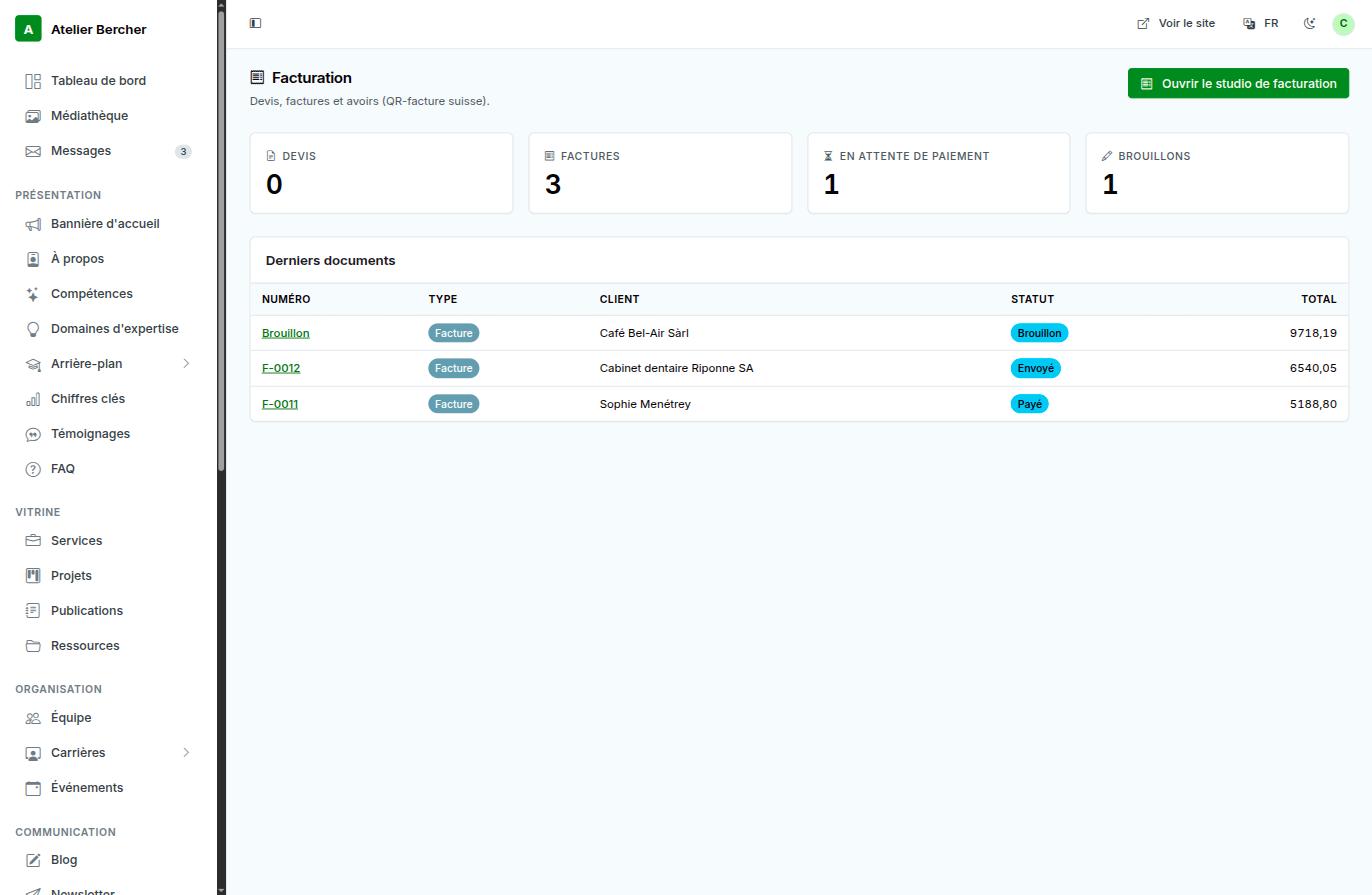
That is what the invoicing module does — it is an add-on at 9 CHF per month, and it is worth turning on the day you are still invoicing from a spreadsheet. If you already have an accounting package you are happy with, keep it.


